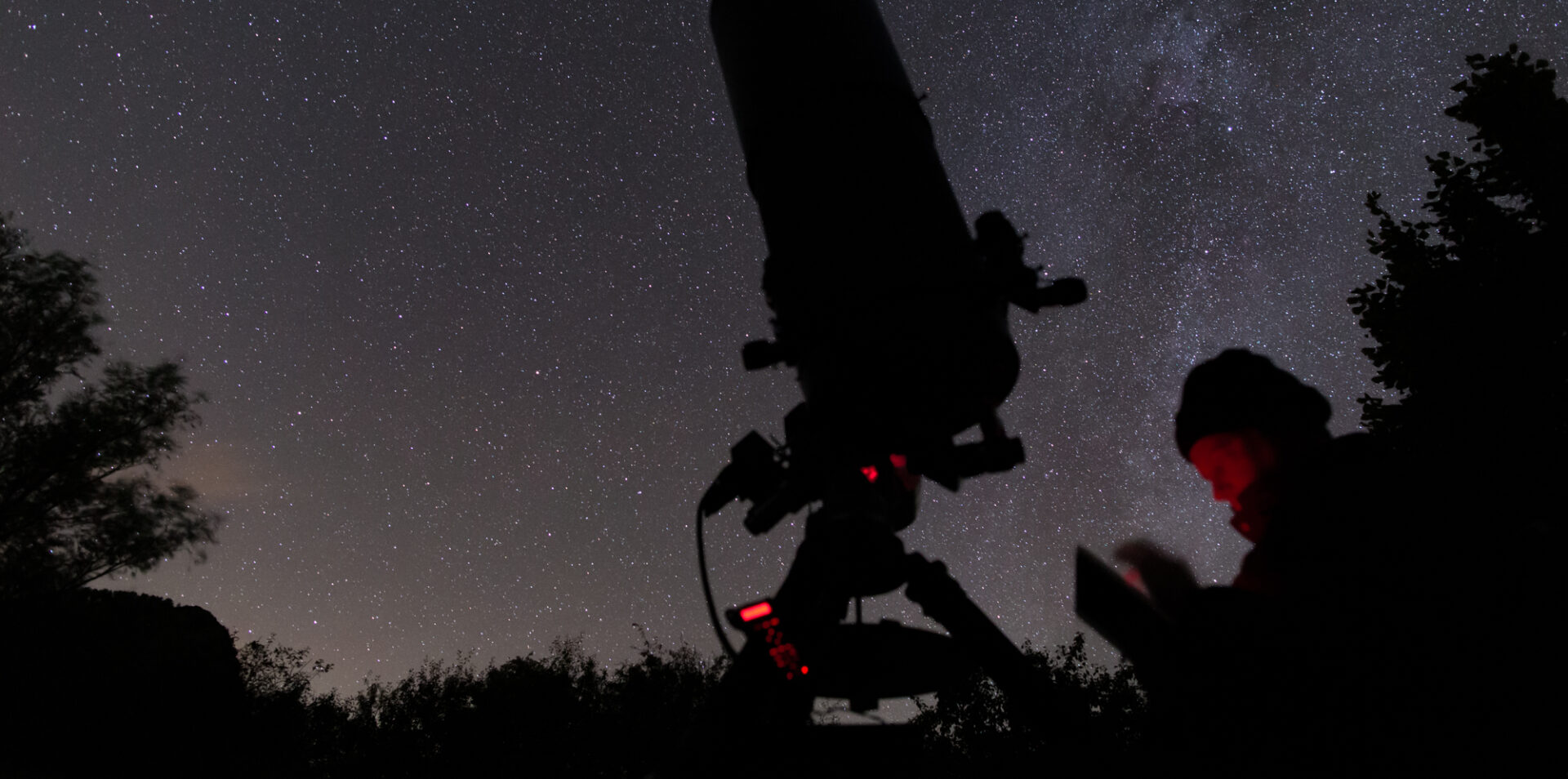
Make visible what, without you, might perhaps never have been seen.
- Robert Bresson
CSOG's main content is the observing guides. Using the guides, observers will know before, during and after an observation what it they are looking for, what it is they are observing and what other objects are visible in the vicinity. The guides take out all the guesswork.
Depending on the edition, CSOG guides come in any or all of 4 different formats:
'By constellation' format & object categories
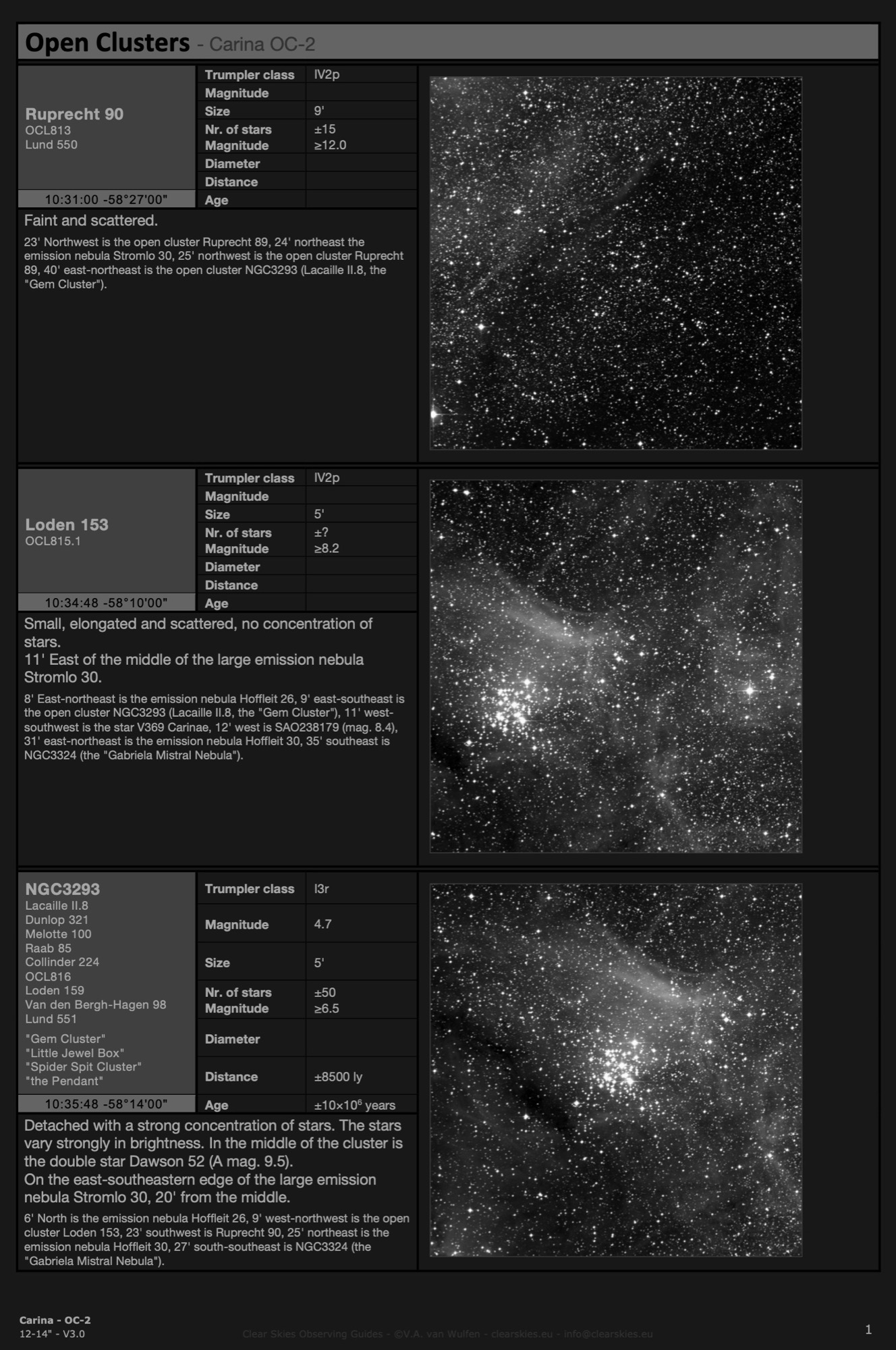
In the 'by constellation' format as, is used in the guides for the Constellation editions by telescope aperture, the guide's title is the object category with the constellation's name and - where applicable - the number of the guide for the (abbreviated) object category in that constellation. For example, the second open cluster guide for the constellation of Cygnus is named Open Clusters - Cygnus OC-2. The abbreviated observing guide title is also included in the page footer.
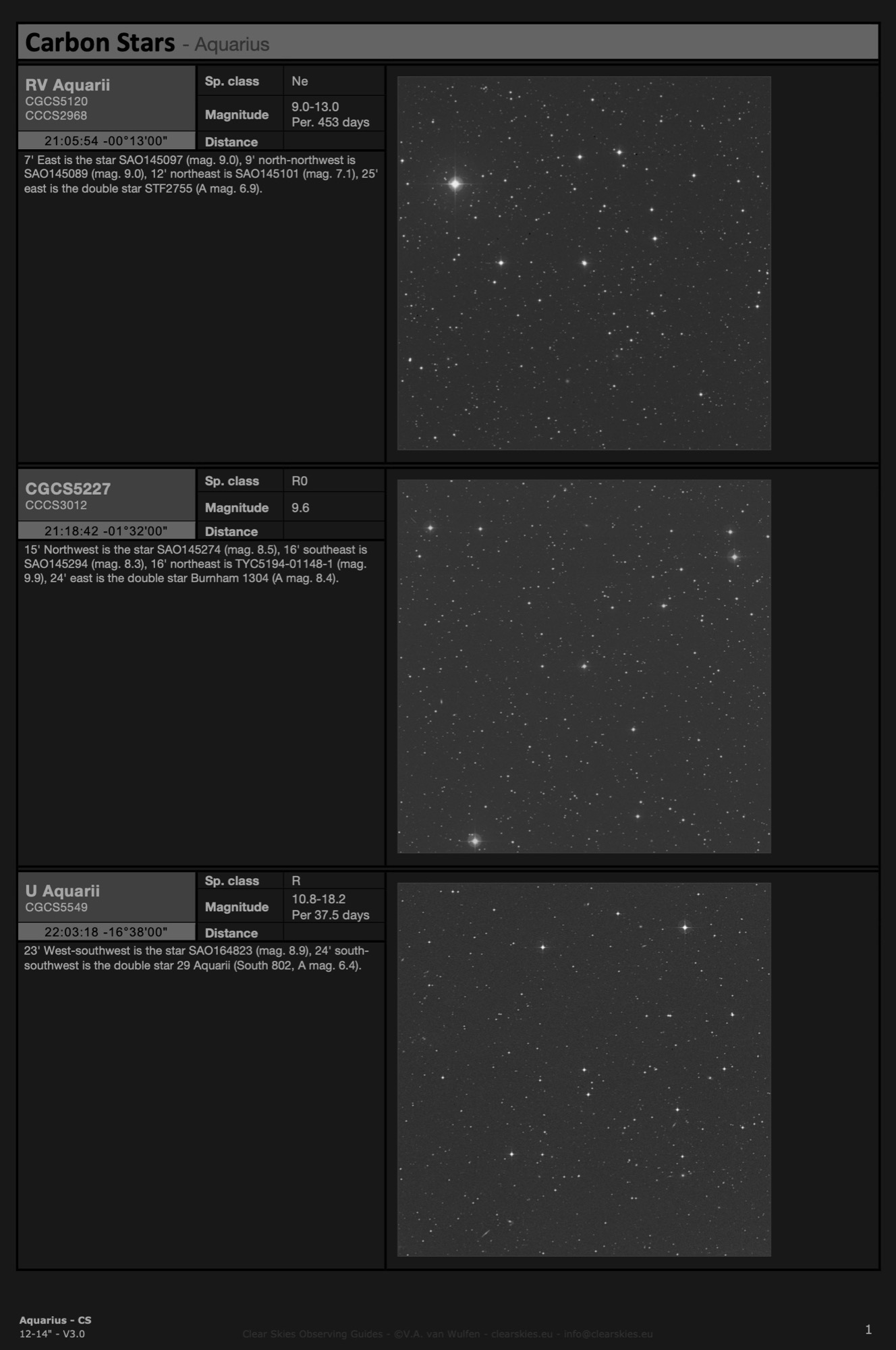
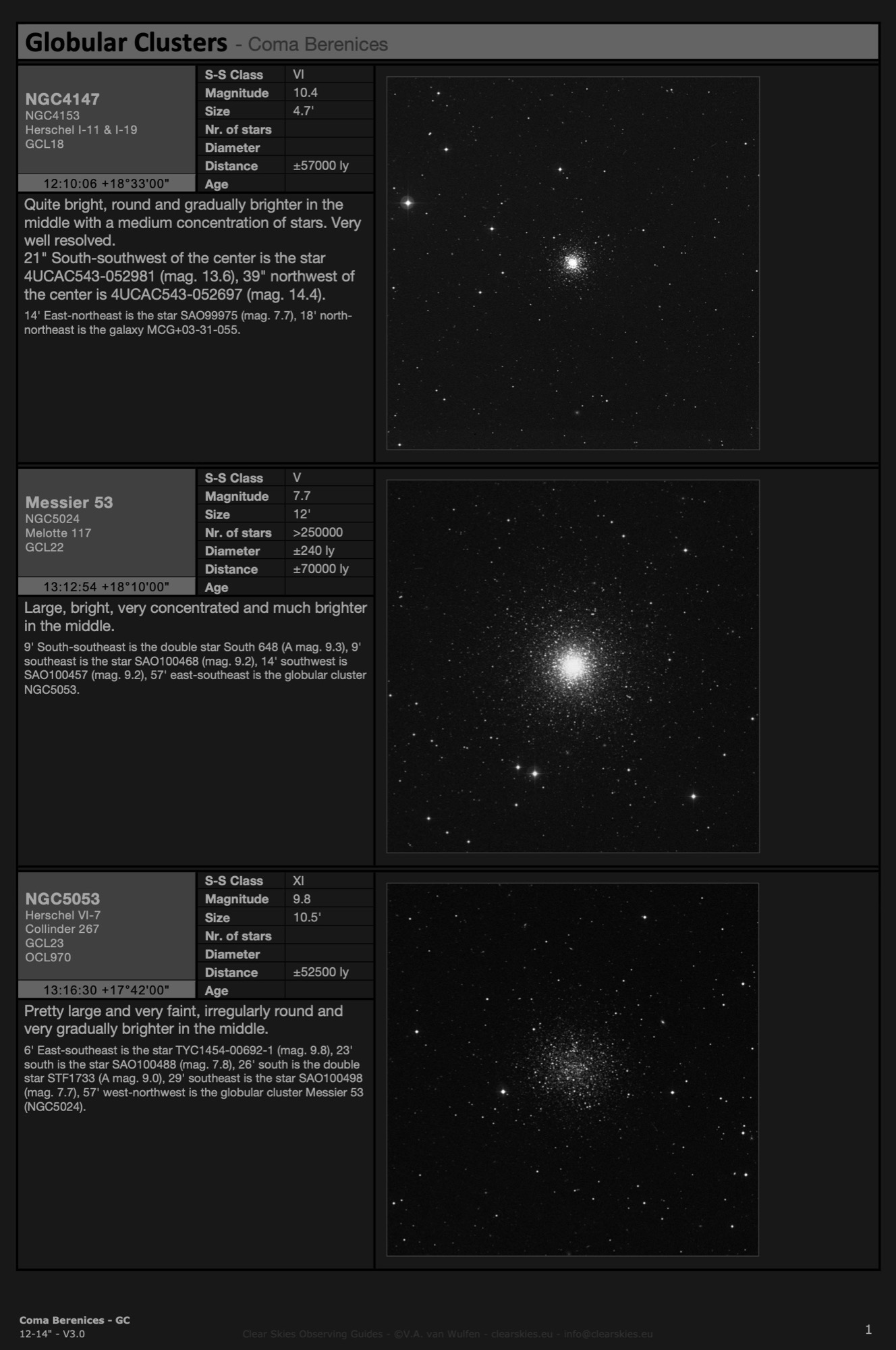
'By constellation' observing guides contain a maximum of 3 objects per page.
The object categories in CSOG's 'by constellation' editions are, with abbreviations:
Carbon Stars - CS
Open Clusters - OC
Globular Clusters - GC
Emission & reflection nebulae - Neb
HII Regions in galaxies - HII
Dark Nebulae - DN
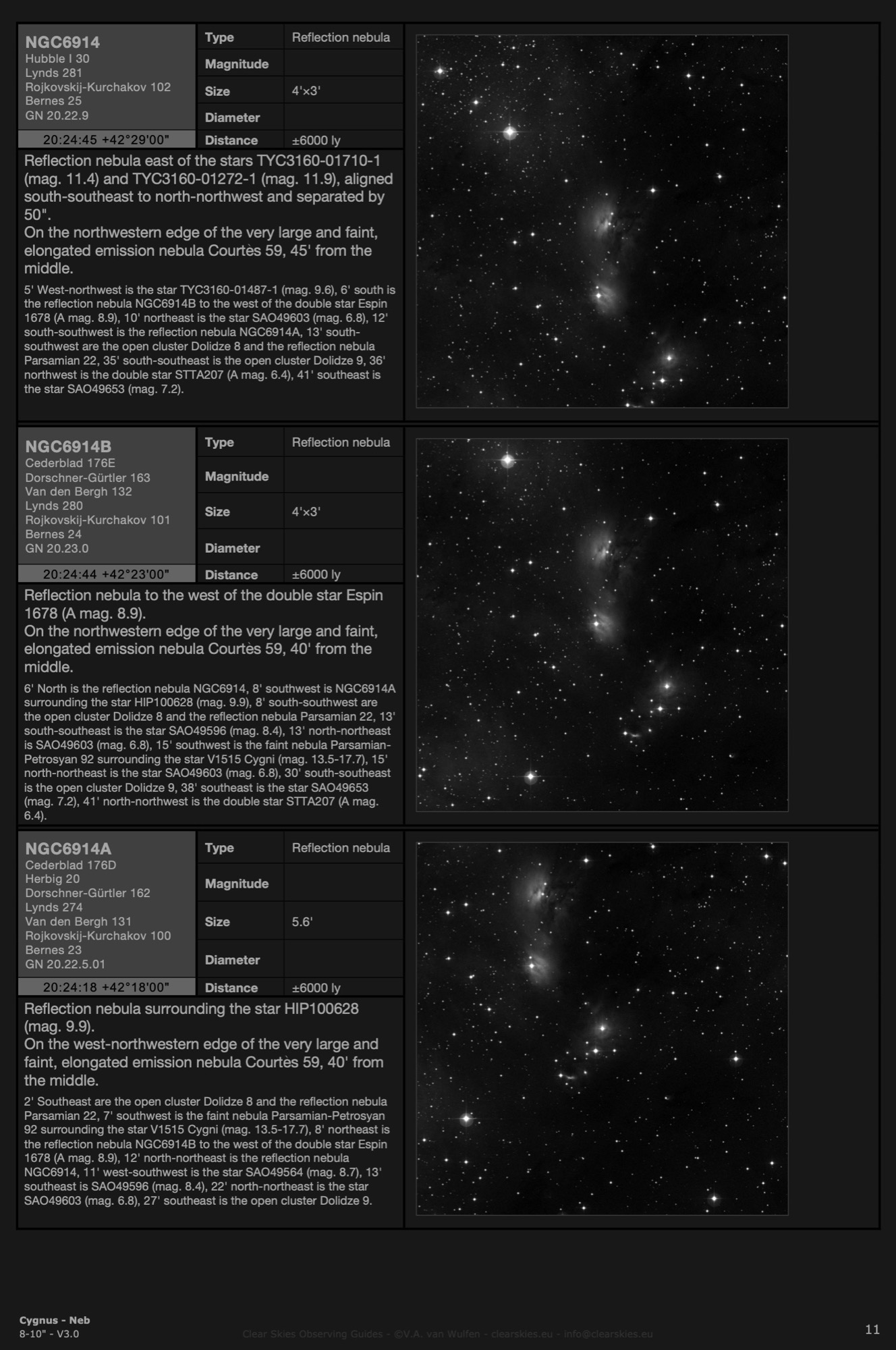


Planetary Nebulae - PN
Supernova Remnants - SNR
Nova Shells - NS


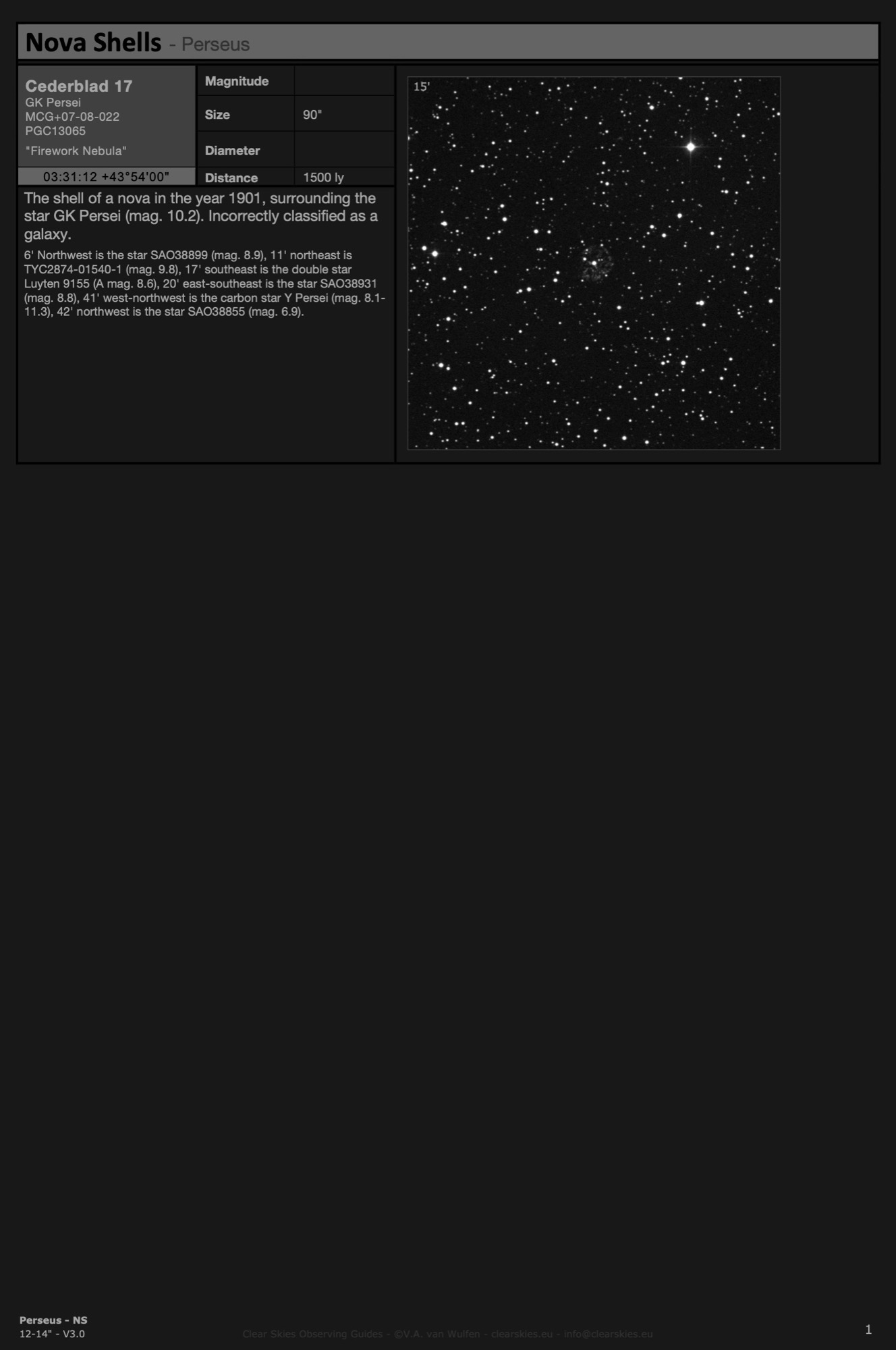
Protoplanetary Disks - PPD
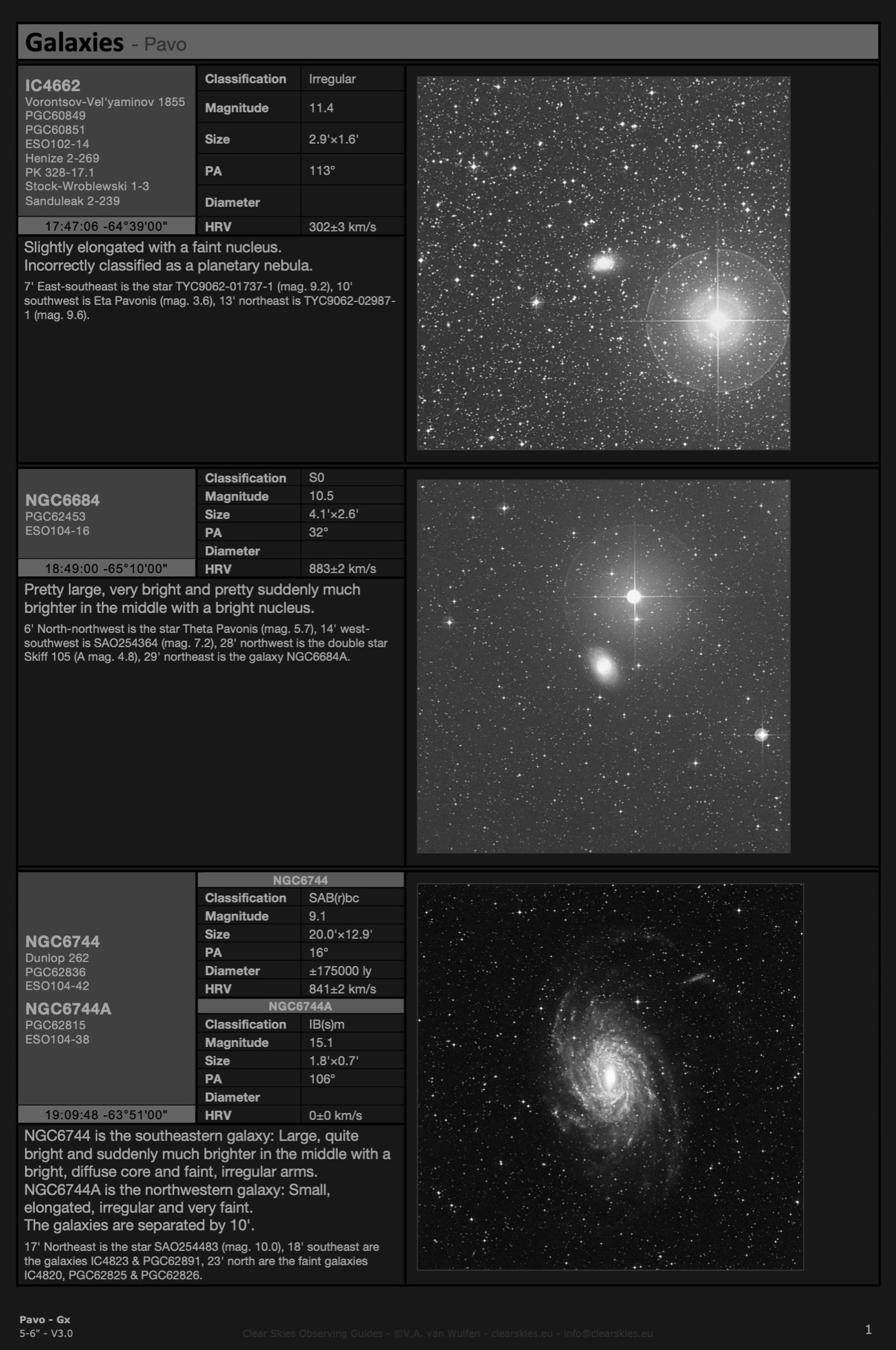
Galaxies & Galaxy Groups - Gx
Asterisms - Ast


Star Clouds - SC
Quasars - Qsr
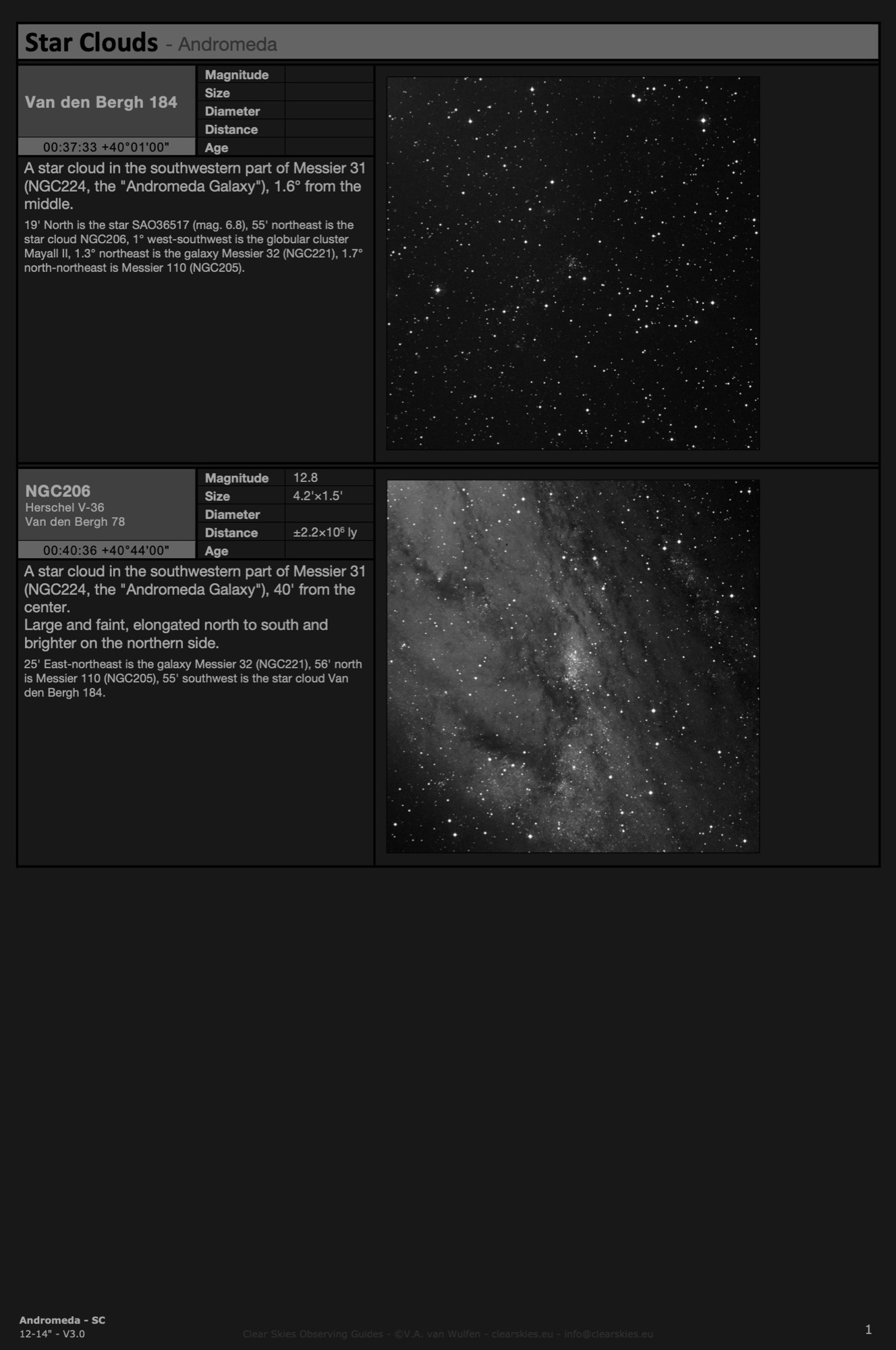
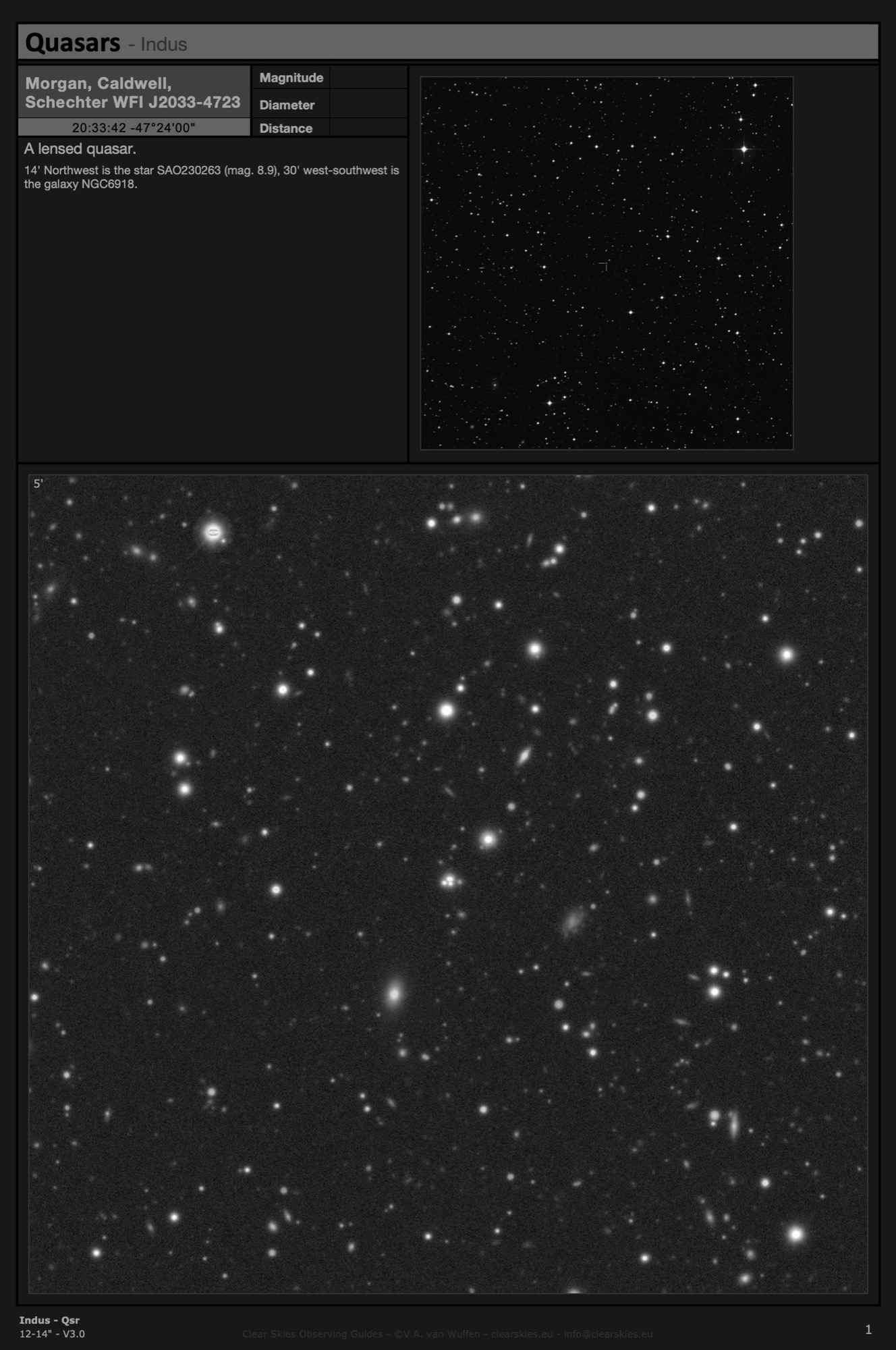
'Sequentially'
Various CSOG editions, such as the Star Cluster editions, some of the smaller Nebula editions and editions for well known lists such as the Messier edition, contain complete catalogs with objects listed sequentially: by number.
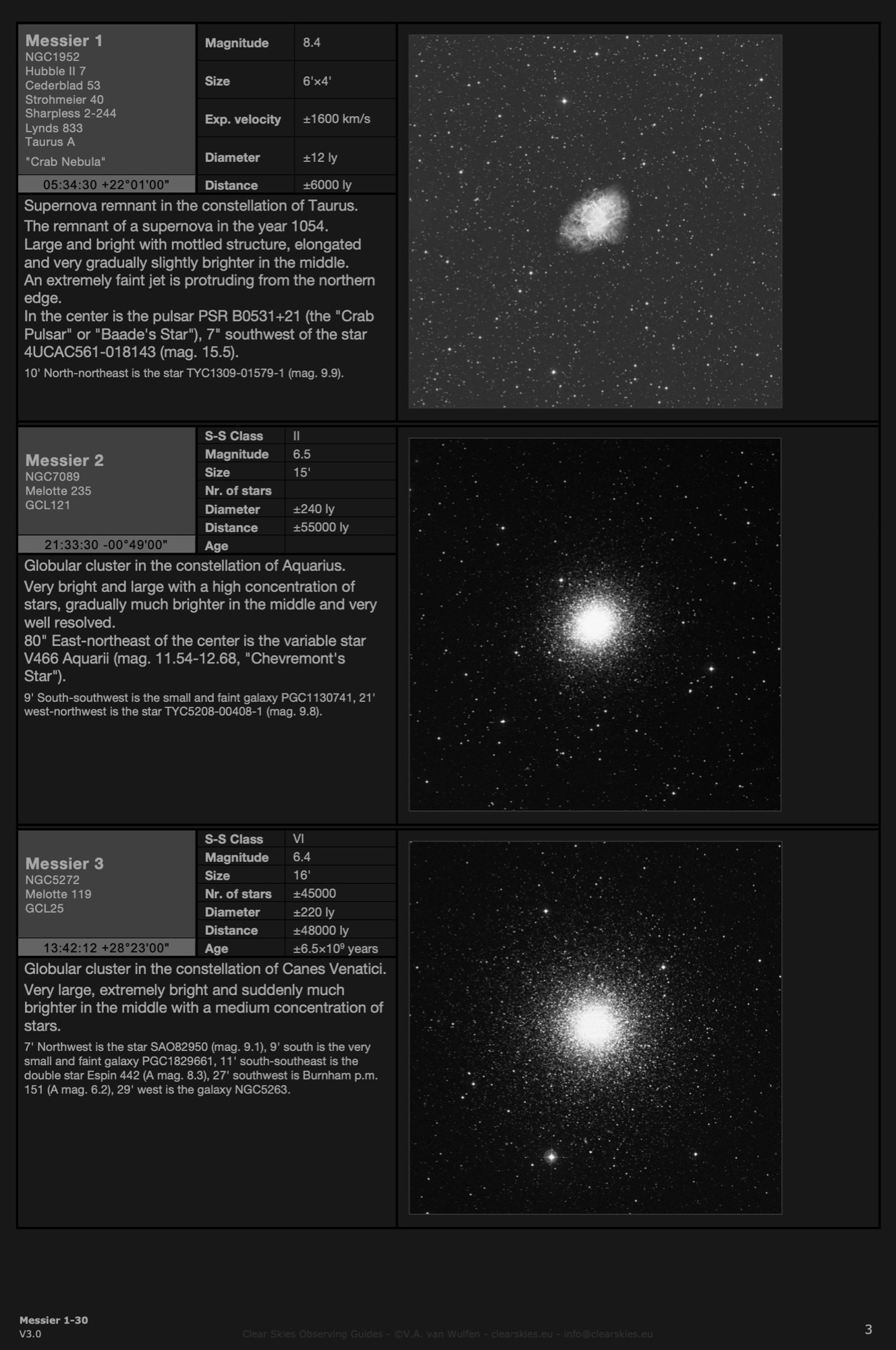
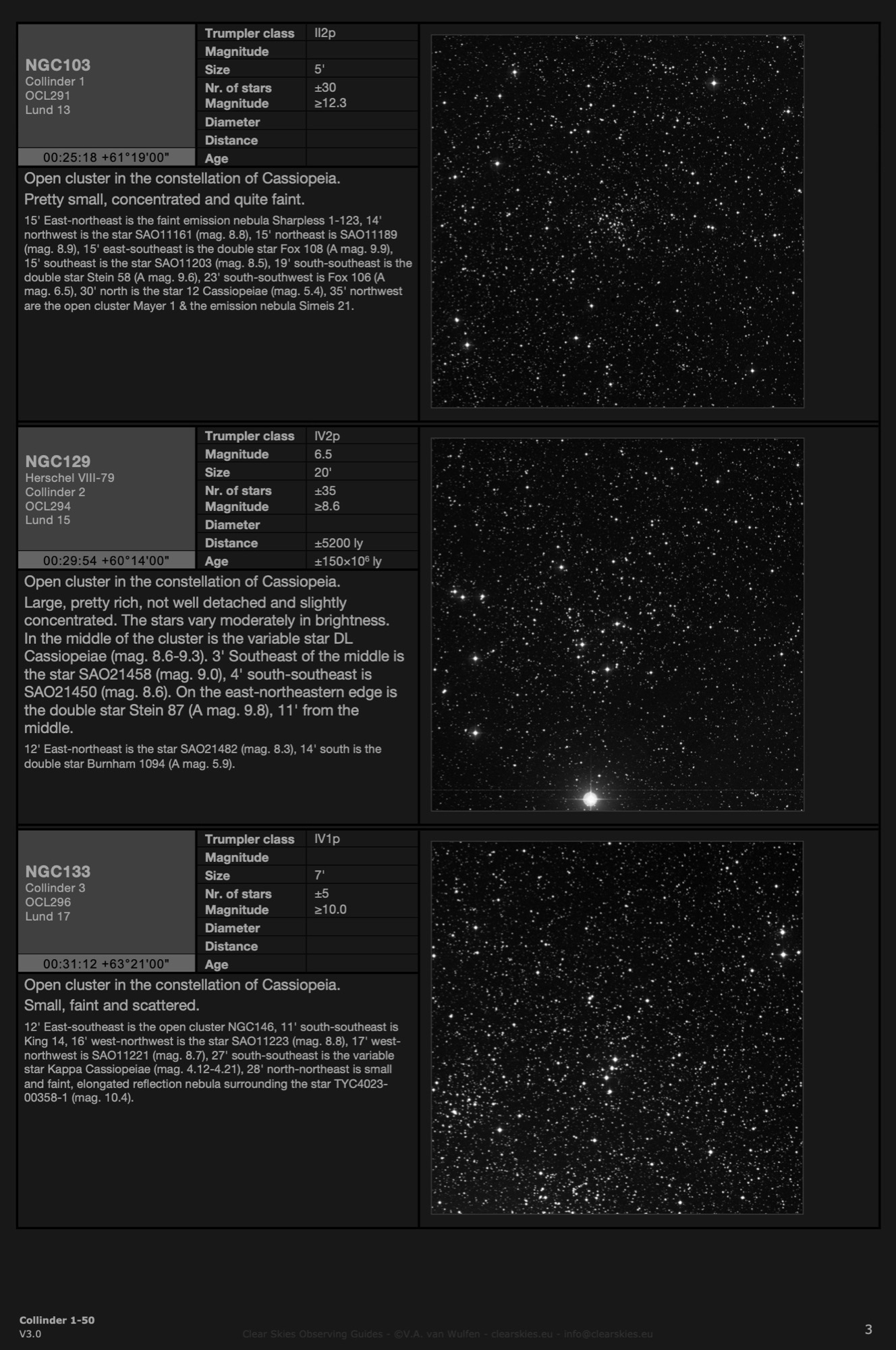

'By object' format
Many CSOG editions contain observing guides for single objects or a single group of objects. These guides feature a large image with minimum size of 15’ (fifteen minutes of arc, a quarter of a degree), that fills the page left to right. All galaxies and planetary nebula guides in this format, where within the SDSS footprint, also contain an SDDS image. The final pages of these guides contain a 75' or larger image that depicts more of the surroundings, to function as a finder chart.
As the 'by object' guides use a larger format, there is more room to include relevant object information, such as catalog notes.

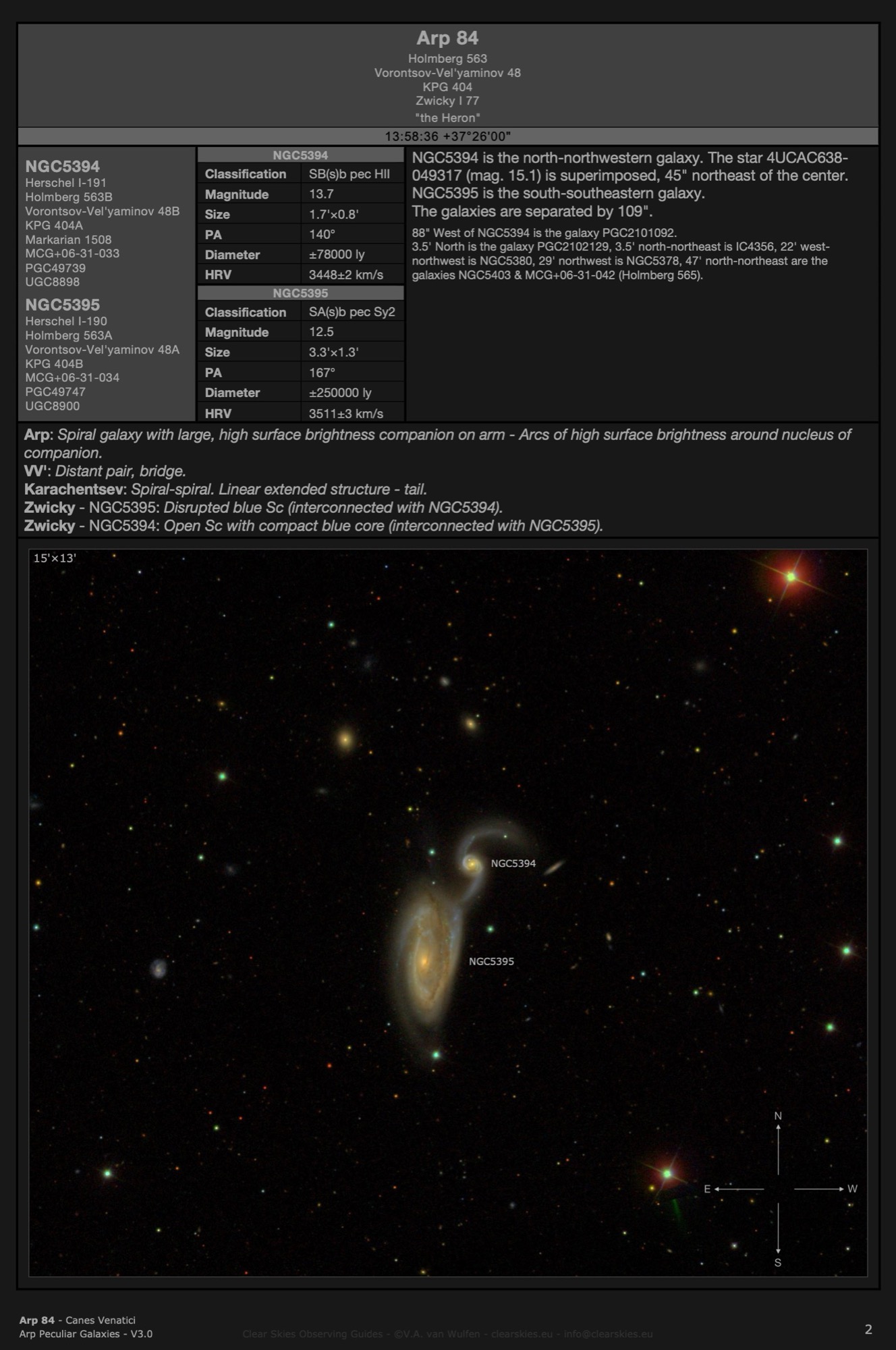
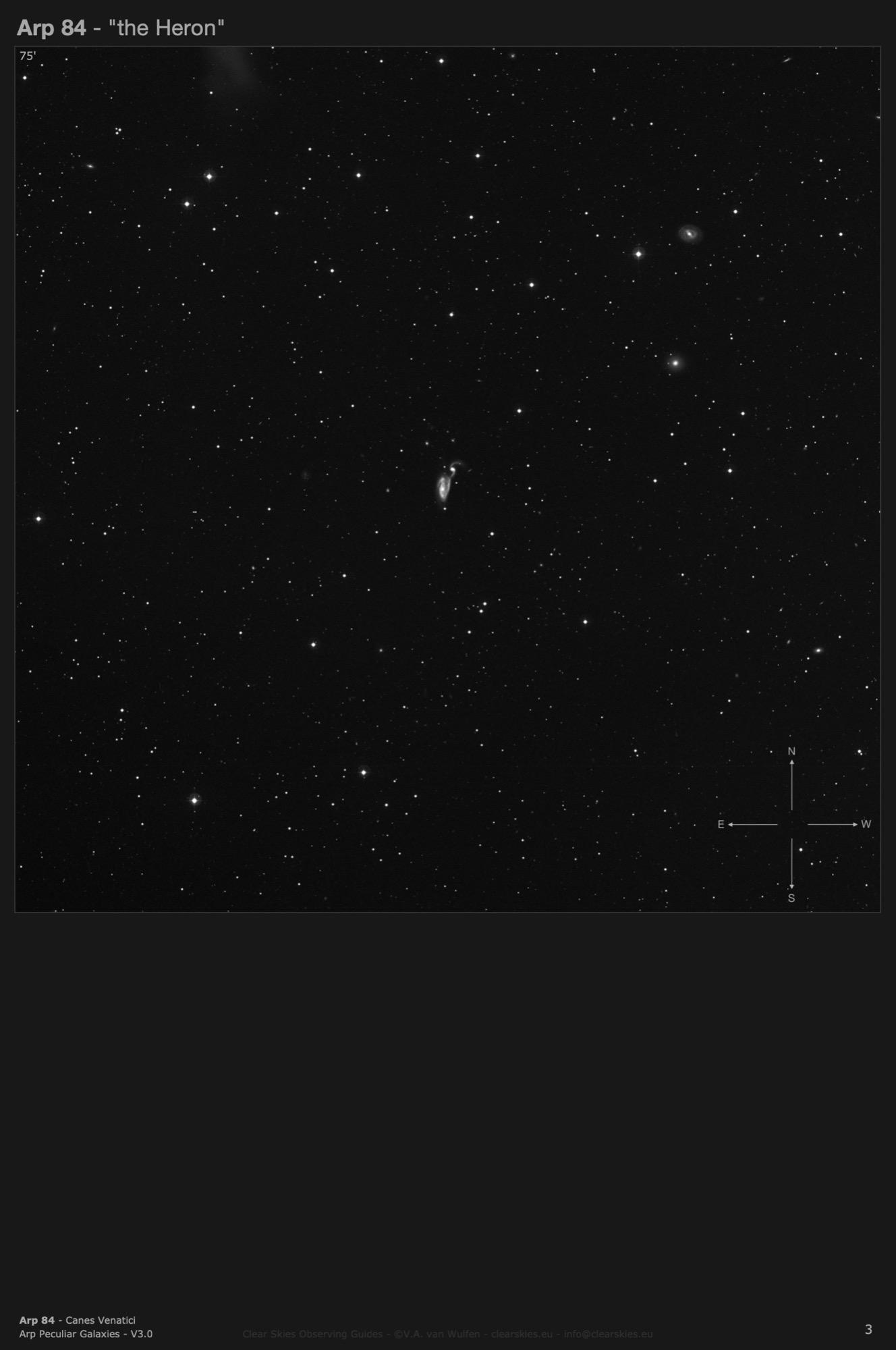
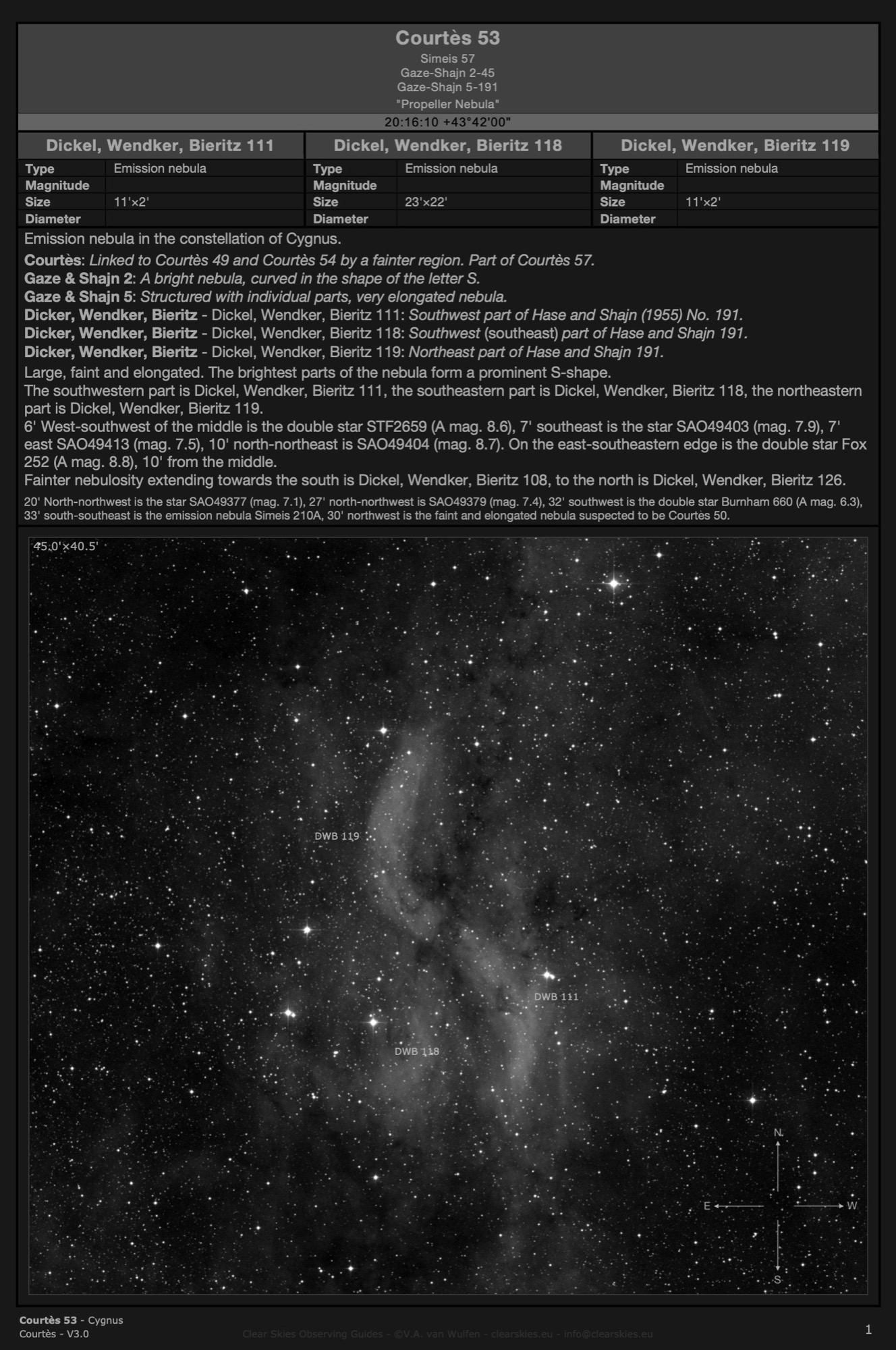

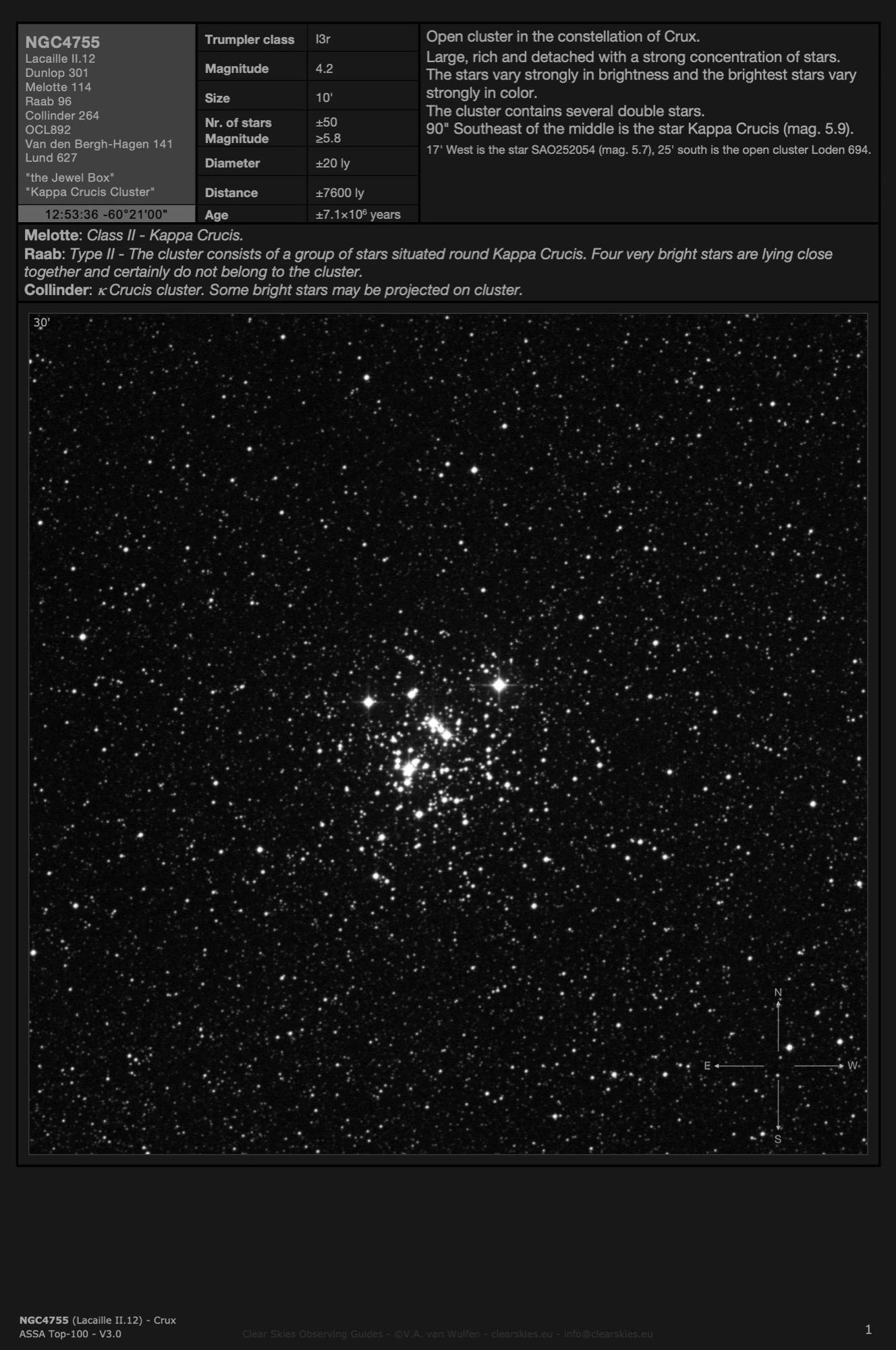
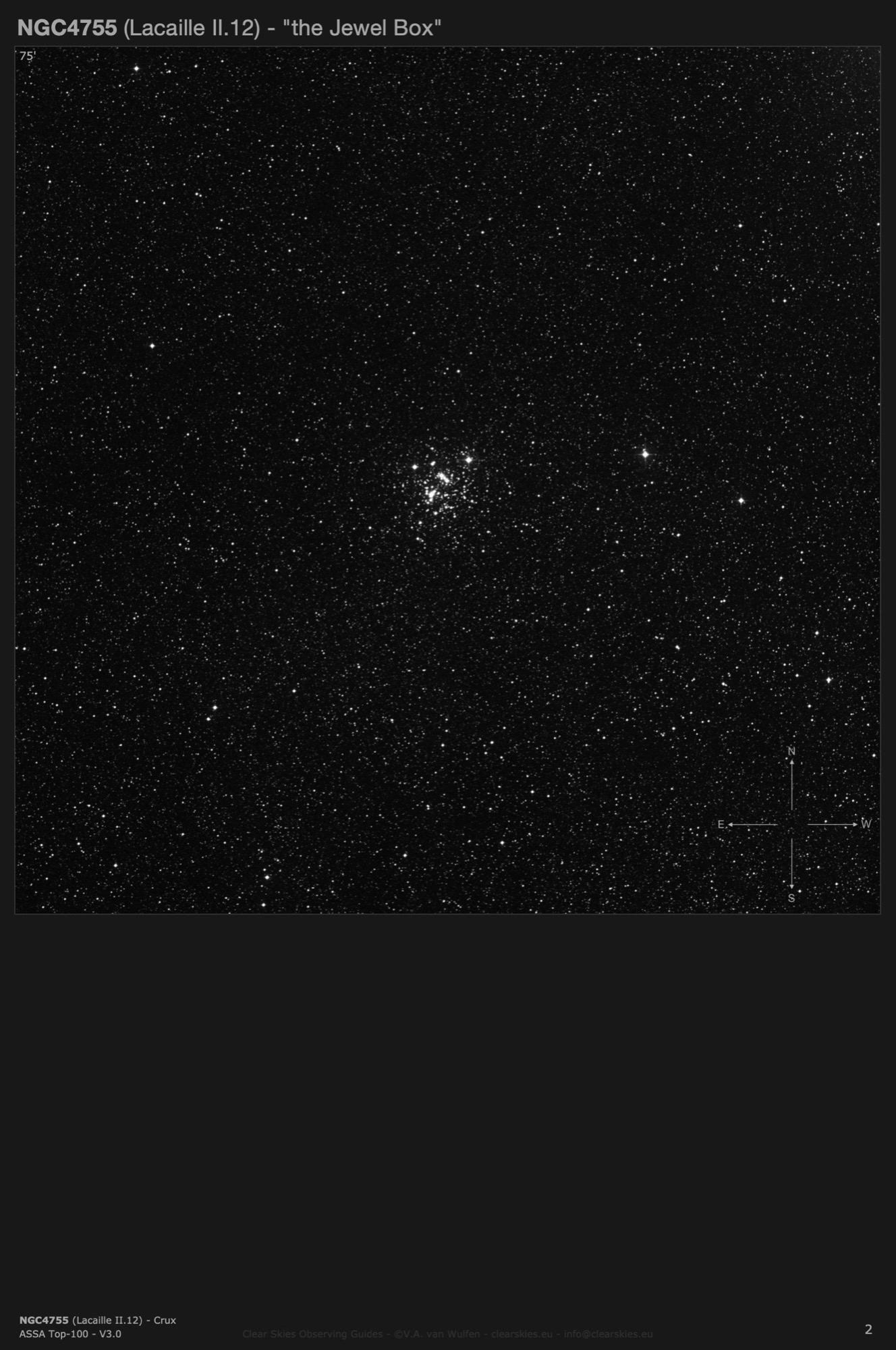
CSOG's Double Star Editions observing guide format
Contrary to the observing guides for deepsky objects and carbon stars, the observing guides for CSOG's Double Star editions do not contain images. However, when using CSOG's double star observing guides at the eyepiece, on a tablet as per its intended use, extra information and an image can often come in handy. For example, when a close double in a busy star field is to be split and it's difficult to determine which star in the field of view is (the primary star of) the double, before applying magnification. Or when you want to determine if something faint and fuzzy nearby is perhaps a galaxy or nebula, whether that concentration of stars nearby is a cluster, etc.
To fix this hiatus, hyperlinks are added to the guides. Clicking the double star's …
- WDS designator in the first column will open the page for that double star on the website Stelledoppie.it;
- Designation in the second column will open a 75' POSS2 Blue DSS image;
- Components in the third column will open a 75' POSS2 Red DSS image;
- PA / Sep. (postion angle & separation) in the fifth column will open the double star in SIMBAD;
- R.A. / Dec. (the coordinate in epoch J2000.0) in the final column will open Aladin Lite, centered on the object in a 30' (1/2°) DSS POSS2 Blue field.
The sample pages below are, respectively, the first page of the Struve Double Stars edition and the first page of the double stars in Burnham's Celestial Handbook edition for the constellation of Andromeda. Please click the download button below to download the samples in pdf, with hyperlinks.

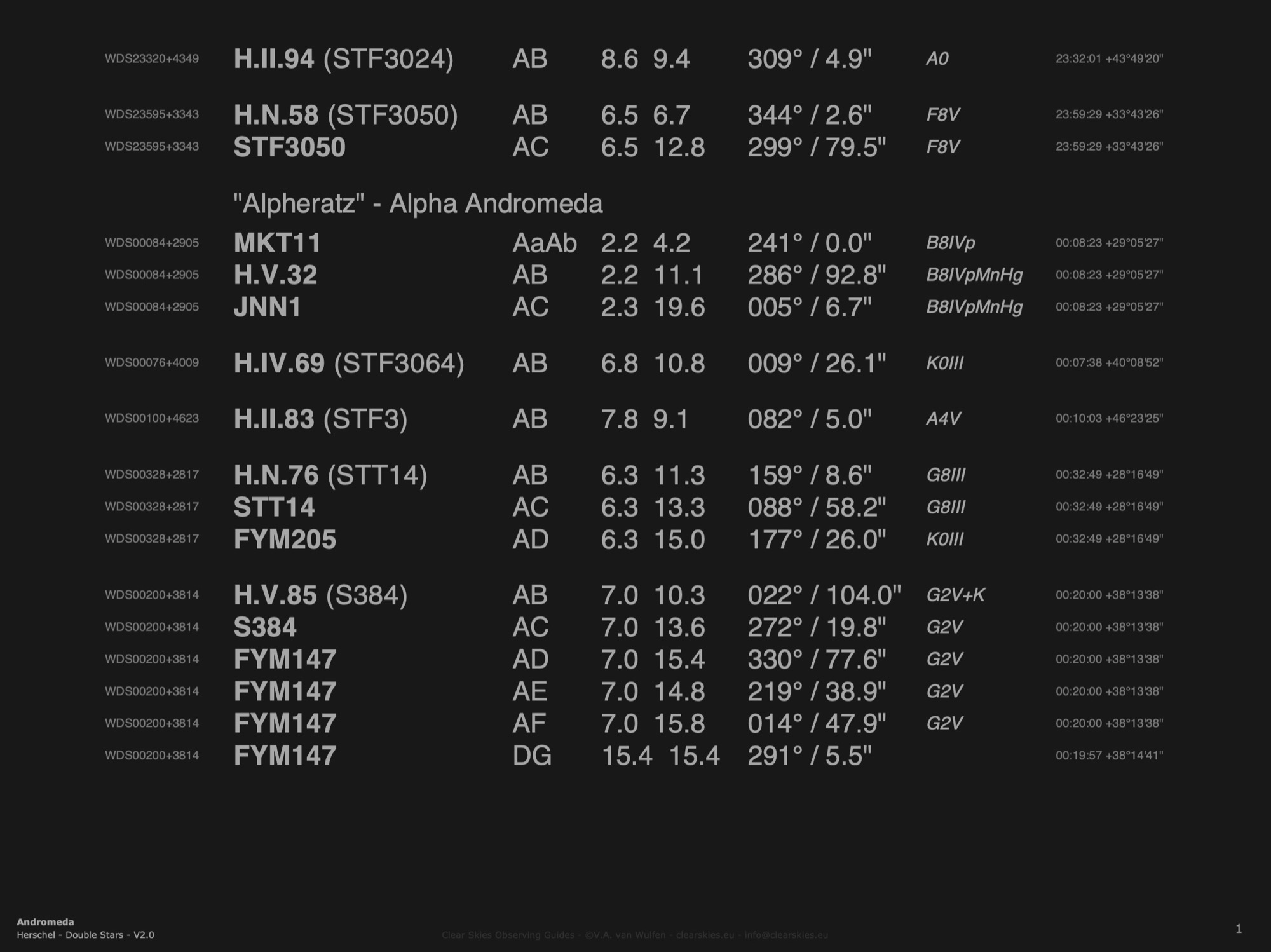

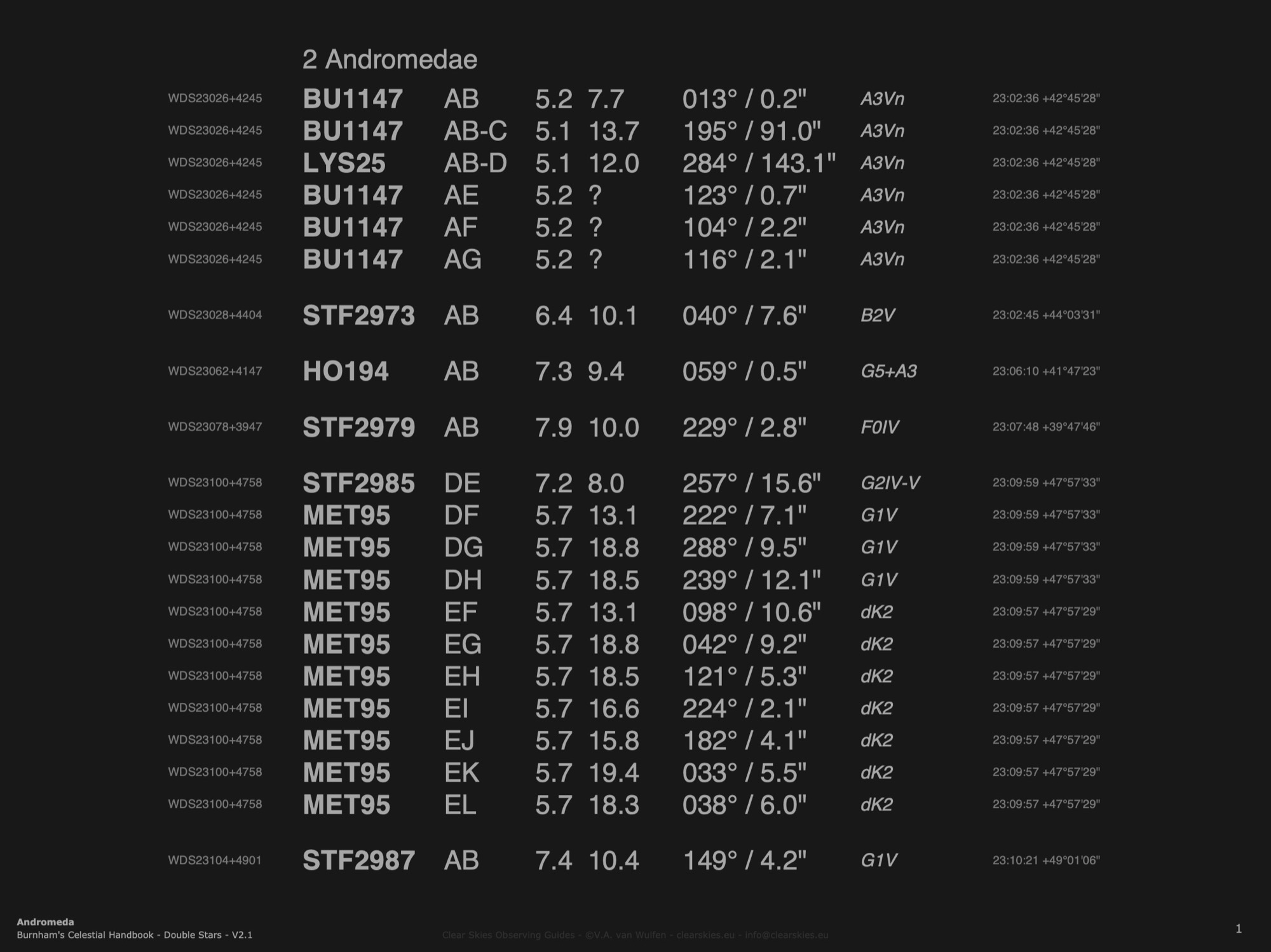
On a tablet, depending on the application used to view the observing guide, links will open directly. For these double star observing guides used on Apple's iPad's, I recommend opening them in the application Filebrowser, as the application will open the links directly "in-app" without briefly generating a white splash screen. On Apple computers a dialogue window will pop up when clicking a link, as this is how the operating system MacOS handles links in pdf's.
Object Designations
Objects are named by their historical designations. Meaning the first catalog to list an object is the primary name. Messier supersedes NGC, MCG superseded PGC, Minkowski supersedes Simeis, Courtès supersedes Sharpless, Melotte supersedes Collinder, etc. That being said: in guides for specific catalogs, emphasis is put on the catalog designation where possible.
For galaxies, MCG (Morphological Catalogue of Galaxies) supersedes PGC (Principal Galaxies Catalogue and Hyperleda), PGC supersedes UGC (Uppsala General Catalogue - a catalog limited in magnitude, size and declination) and UGC supersedes ESO (European Southern Observatory Catalog). Where applicable, "special designations" such as Arp, Vorontsov-Vel'yaminov, etc. follow the primary designation.
Synonym designations are included where applicable. For example, a Messier galaxy also has an NGC designation and an MCG, a PGC, UGC and sometimes ESO designations. A nebula may have a Minkowski designation, Courtès, Simeis, Gaze-Shajn, Sharpless, Lynds, etc. The same applies to every other object category and other designations used.
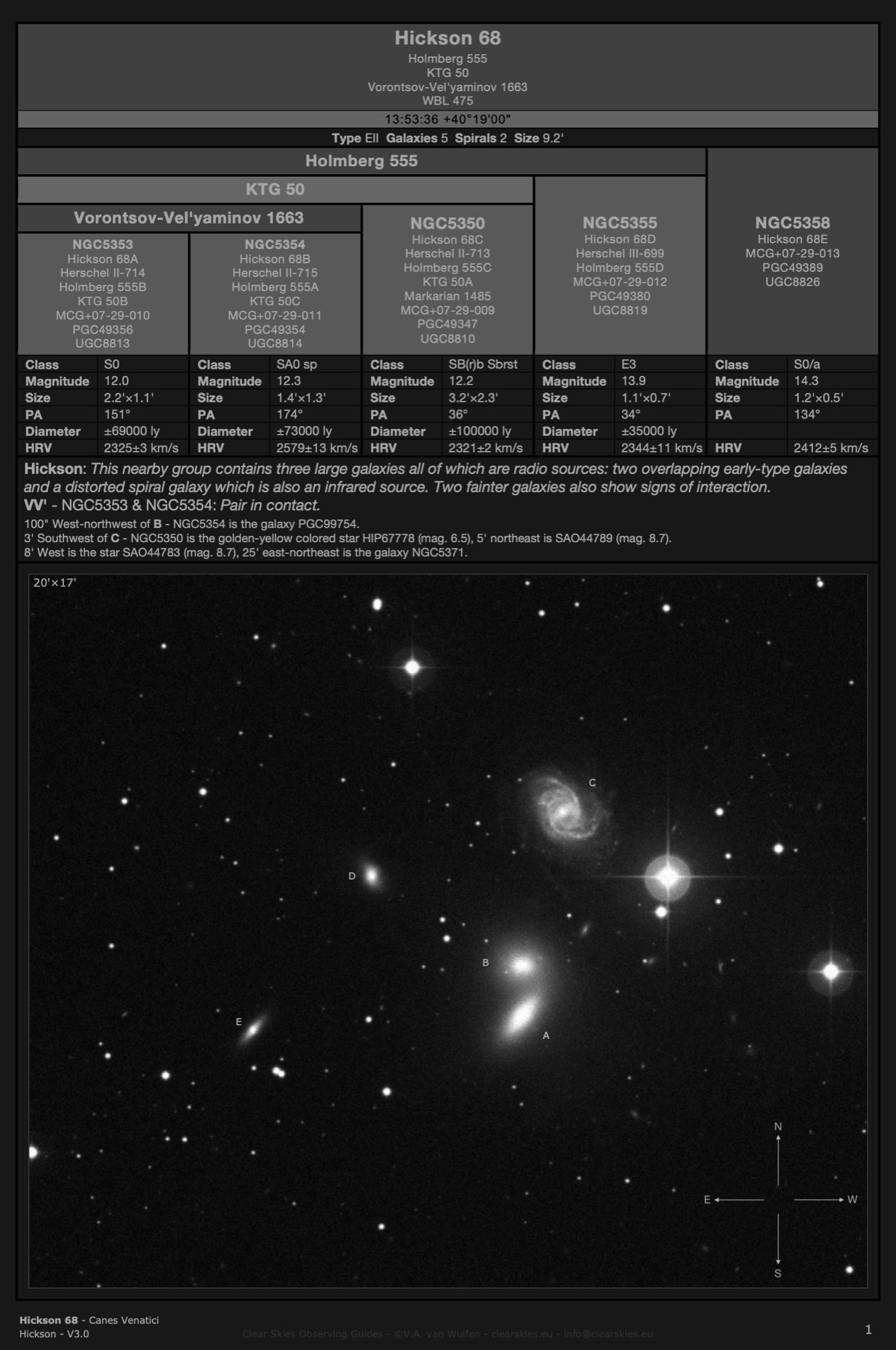
Galaxy groups can contain a melee of designations: a Hickson group can contain an Arp galaxy, Vorontsov-Vel'yaminov, Holmberg, KPG, KTG... For these objects in 'by constellation' editions, historical designations are not leading: there Hickson takes preference over Arp, Arp over Holmberg, Holmberg over Vorontsov-Vel'yaminov, Vorontsov-Vel'yaminov over Karachentsev(a), etc.
Object Information
Below the object's name and its synonyms is its celestial coordinate in epoch J2000.0. To the right, or below in 'by object' guides for groups of 3 or more objects, is relevant data such as magnitude and size, position angle for galaxies, etc.
Instead of using abbreviated Dreyer's descriptions for objects, the description is always in complete words. Therefor you will not find a description such as "pL vF E gbM vbN" but will instead read "Pretty large, very faint, elongated and gradually brighter in the middle with a very bright nucleus".
Field Descriptions
Following object descriptions, a field description is included in a smaller font. Noteworthy objects within 30 minutes of arc (one degree centered on the object, sometimes larger) and relatively bright stars are named, with bearing and distance from the object in the guide: stars up to mag. 10, double stars up to mag. 10 with a separation of 0.7 seconds of arc or greater, carbon stars up to mag. 11 and other objects in CSOG.
For stars, the SAO designator (Smithsonian Astrophysical Observatory Star Catalog), where available, is used as the primary designation, as it's a short and concise designator for a very complete star catalog. Following are HIP (Hipparcos), TYC (Tycho II), then other designations such as HD (Henry Draper), BD (Bonner Durchmusterung), CD (Cordoba Durchmusterung) or 4UCAC.
Catalog Notes
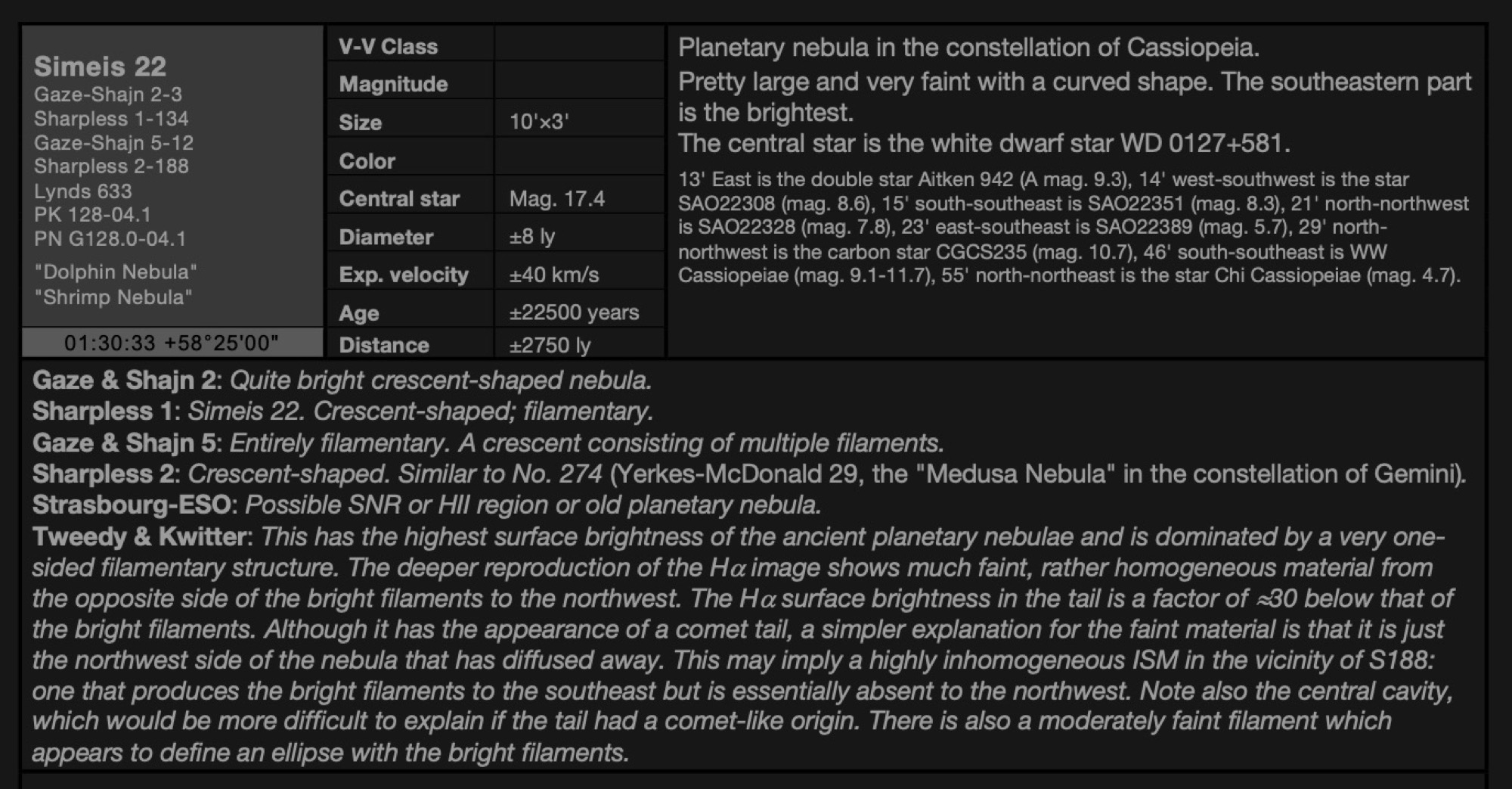
Where available, guides in 'by object' format contain original catalog notes, translated to English where applicable.
Images
Unless noted otherwise in the top left corner of an image, images are 30 by 30 minutes of arc in size (30' × 30', half a degree). Quite a few objects have larger images, with the object size depicted in the top left corner. A few very large objects have even larger DSS mosaics or images from Aladin Lite.
For images in the 'by constellation' and 'sequentially' editions "management by exception" is used: were an image size to always be displayed for every object and every image in these guides, given that the majority of these images is 30' in size, an image size that is not 30' × 30' would not stand out. Therefor, in these guides, the image size is displayed only when a size other than 30' × 30' is used. The sole exception being images for in these guides for objects in the 'by object' format, which is the case for large objects, galaxy groups such as the Hicksons and for objects that can be considered as showpieces.
CSOG images are uncompressed. This is intentional as thereby the option to zoom in on images is retained. It is the reason the observing guides' files are quite large in size.
There are no esthetically pleasing color images in CSOG. This is intentional. The guides are written to make the most of an observing session and are intended to primarily be used at night, behind the eyepiece of a telescope.
The DSS images provide a fixed reference, a "standard candle" for visual astronomy with a known size and known image orientation. Contrary to arbitrarily orientated candy cane images used in most other publications, this will actually display an object close to its appearance in the eyepiece.
Image Orientations
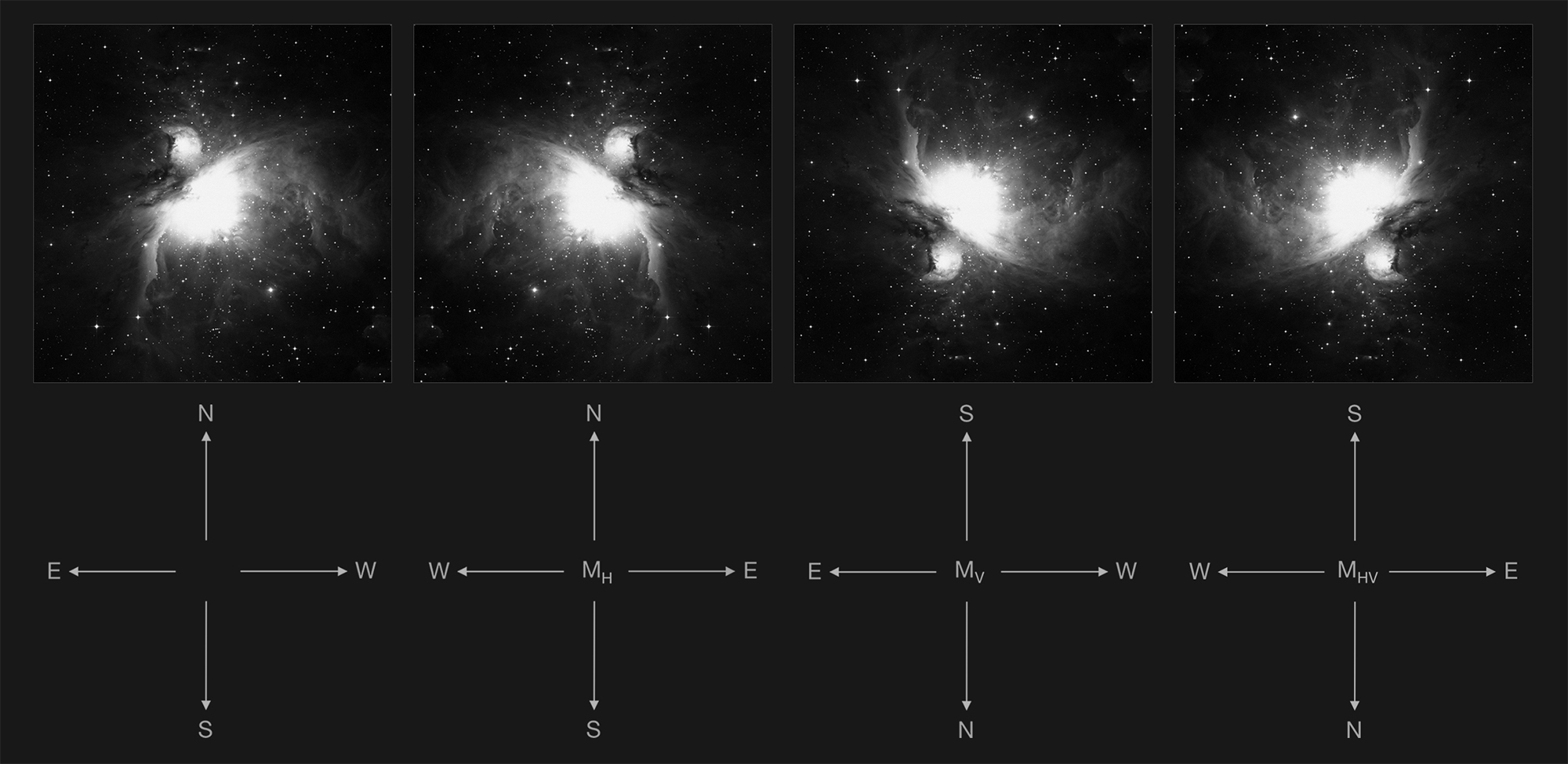
There are 4 image orientation options:
- Unmirrored: North up, west to the right
- Mirrored horizontally - MH : North up, west to the left
- Mirrored vertically - MV : North down, west to the right
- Mirrored horizontally & vertically (= rotated 180°) - MHV : North down, west to the left
Click here to read more about CSOG image orientations and their field use.
Object sorting & blocks of declination
In the editions that contains 'by constellation' guides, objects are sorted by constellation and by object category. There are no more than 3 objects per page and, as a rule of thumb, no more than 30 objects per observing guide.
Objects are generally sorted by right ascension (R.A.). That means starting in the west and working towards the east, but not purely in R.A. When the next object is nearest in right ascension, it may not be the closest as its declination may differ significantly from the preceding object, when another object may be much closer in declination but only slightly farther in right ascension. Therefor, CSOG objects are sorted so that the distance between objects is minimized. Also, objects in large constellations are divided into "blocks of declination". This allows for objects to be sorted logically in smaller parts of a constellation, thereby minimizing large jumps in declination. This makes CSOG a very effective tool for constellation sweeping.
Use of...
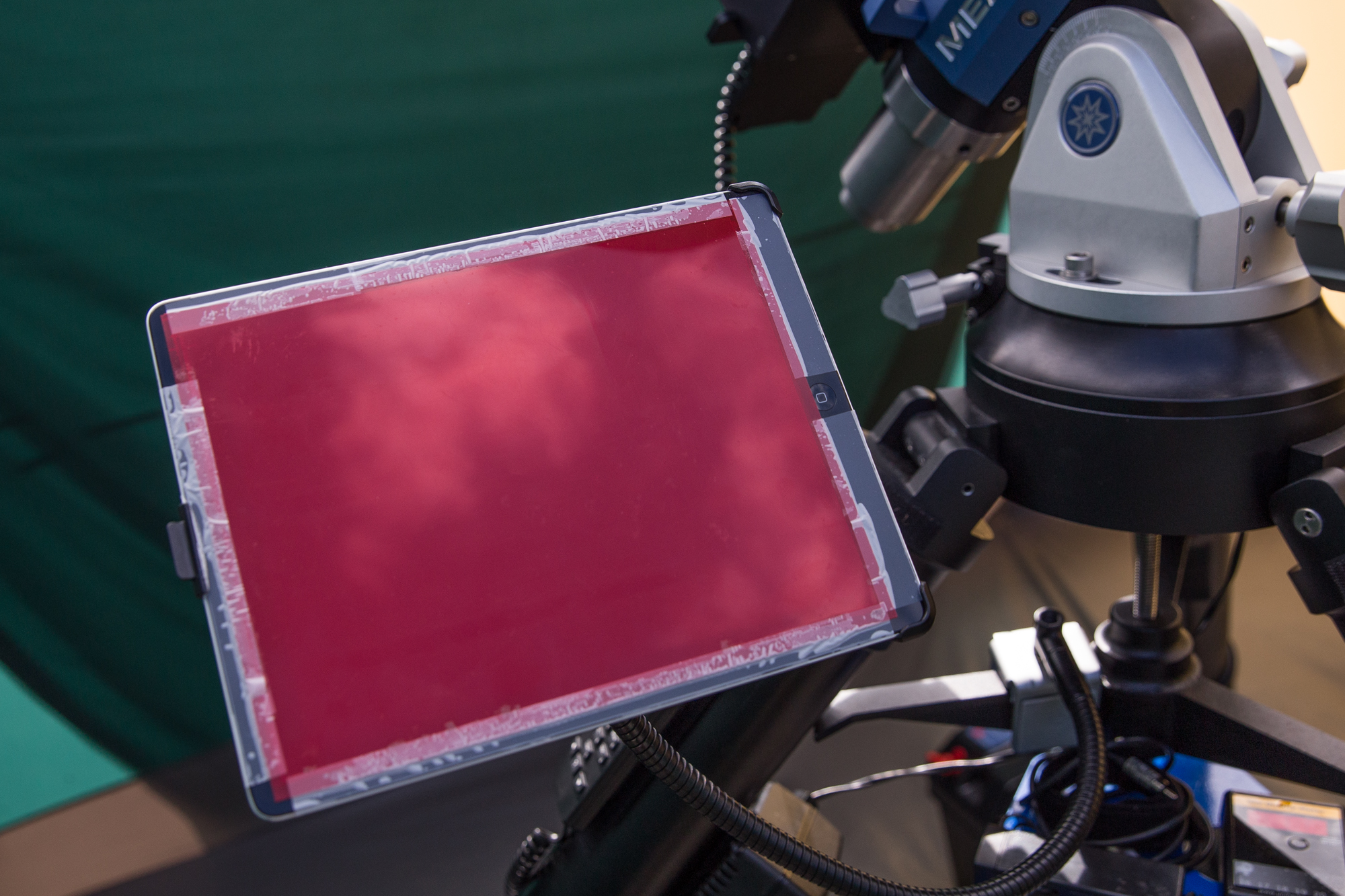
CSOG guides are intended to be used on a tablet, at the eyepiece of a telescope. Please read iPad Astronomy.
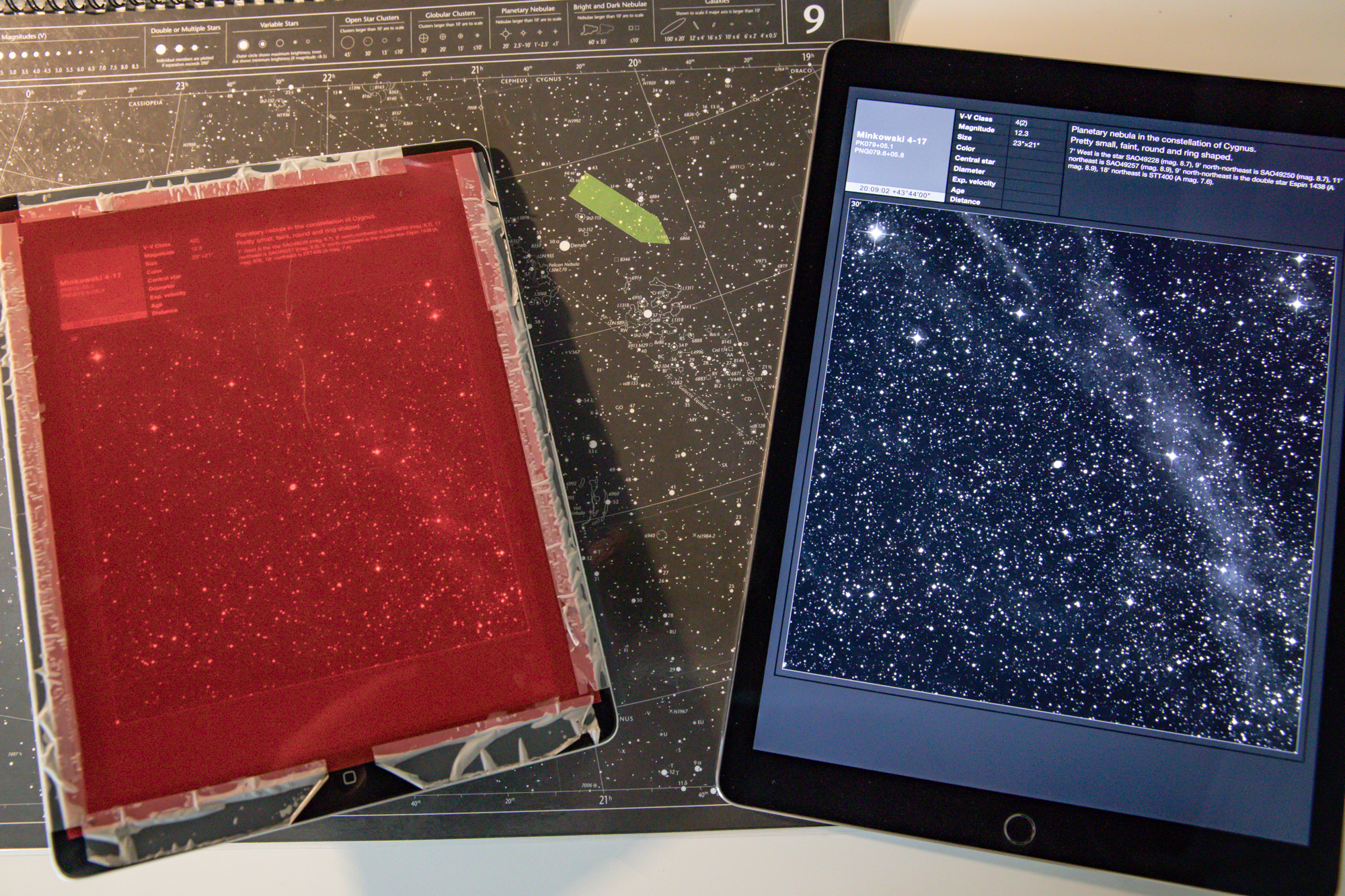
But CSOG is so much more than observing guides: it's the ultimate planning tool. Also thanks to the matching AstroPlanner planfiles that are included with every edition.
There is no other publication that contains as much information on objects, their designations and their positions. Using CSOG you will quickly find how little information and how many errors and inconsistencies existing star charts contain: from historically incorrect designations to stars marked as planetaries and objects missing altogether. That, however, does not mean you cannot continue to use the star charts you own: just use CSOG to plan your sessions and mark the position on the chart, even when the chart itself does not include the object. After all, the only thing a star charts needs is an "X marks the spot".
In the image below, the position of the planetary nebula Minkowski 4-17 in the constellation of Cygnus is plotted on Sky Atlas 2000.0, even when the atlas does not included the object.
Basic knowledge
To use the observing guides effectively, basic knowledge of the sky is required. It helps to be familiar with the celestial coordinate system (right ascension and declination) and units of measure (degrees°, minutes' and seconds") for both celestial coordinates and angular dimensions. Basically, you need to be able to read a star chart.
Understanding cardinal directions in the eyepiece of your telescope (north, south, east, west) will aid in locating objects, finding object details and to locate objects mentioned in the field descriptions. Knowing the actual field of view of your telescope-eyepiece combination will help to compare an object's image to the view in your eyepiece and vice versa.
No starcharts
There are no CSOG specific starcharts. That does not mean CSOG is goto-telescope only. Starcharts are not included because the chart you already own will be all you need.
For all of the objects the celestial coordinates are included. This allows you to easily plot an object's exact location on your starchart, even when the object is not depicted on the chart. After you make the star hop and have the telescope pointed to the area where the object is, the DSS image takes over to locate the exact position of the object. No matter how small or diffuse.